
Driven by increasing demand from AI applications, advanced semiconductor fabs are entering a new cycle of expansion. In this context, overhead hoist transport (OHT) systems within AMHS have evolved from an optional solution to a foundational component of fab infrastructure.
As more companies enter the market and more projects move into deployment, a common perception is beginning to emerge: if a company can deliver OHT, it is considered capable of providing AMHS.
However, in real fab environments, this assumption is often quickly challenged.
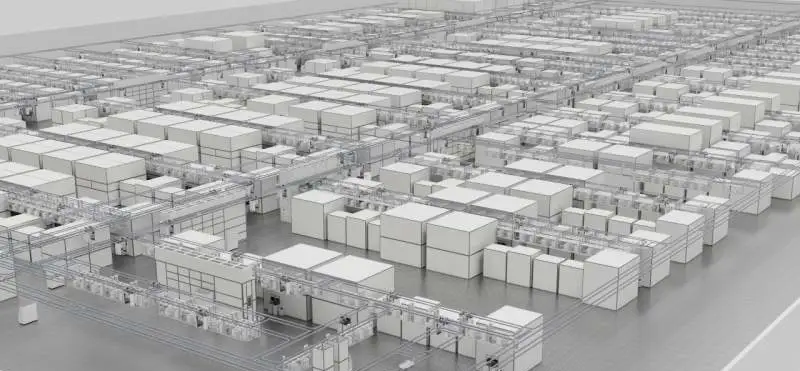
Once an OHT system is deployed, what customers truly experience is not simply whether the system exists—but how well it performs.
Some systems operate smoothly during demonstrations. Yet under real production conditions—where multiple tasks run concurrently, routes intersect, and takt times fluctuate—issues such as waiting, congestion, and instability begin to surface.
At this stage, a more fundamental question arises:
Do customers need a system that merely runs, or one that can consistently deliver high performance?
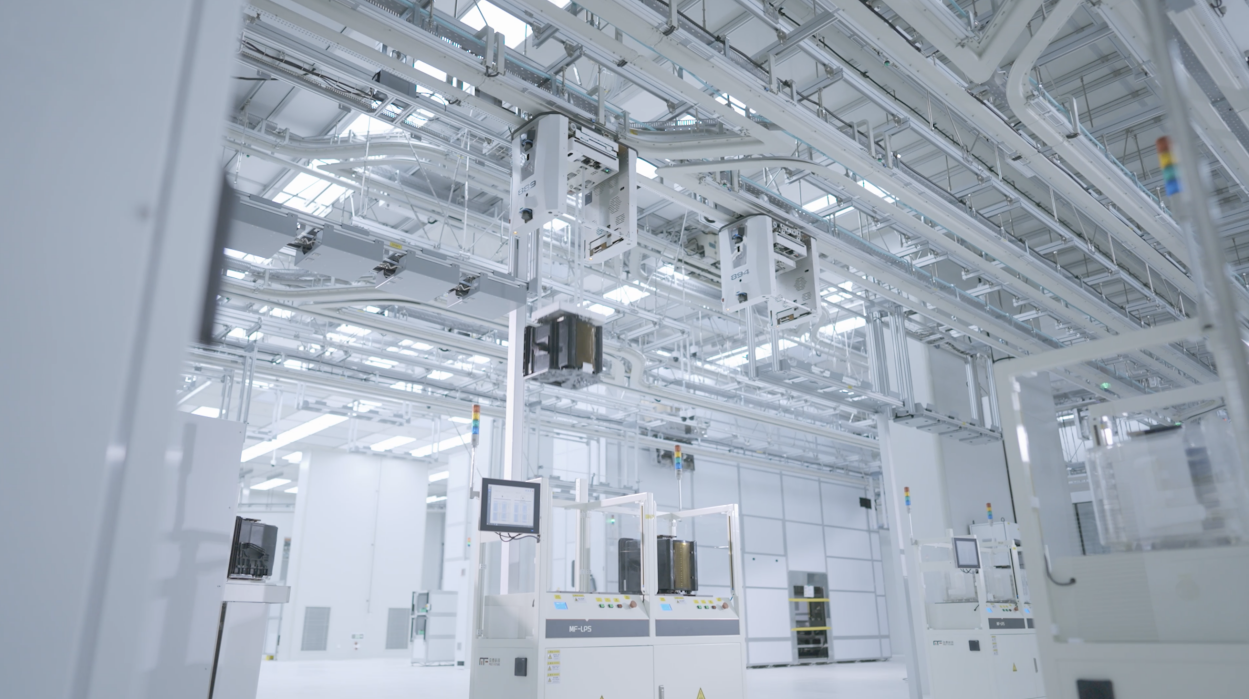
In semiconductor manufacturing, AMHS is never just a transport tool—it is an integral part of the production system. It must maintain determinism under uncertainty and sustain stable output within complex operating environments.
Therefore, the true measure of a system is not simply whether it is functional, but whether its efficiency can be trusted over the long term.
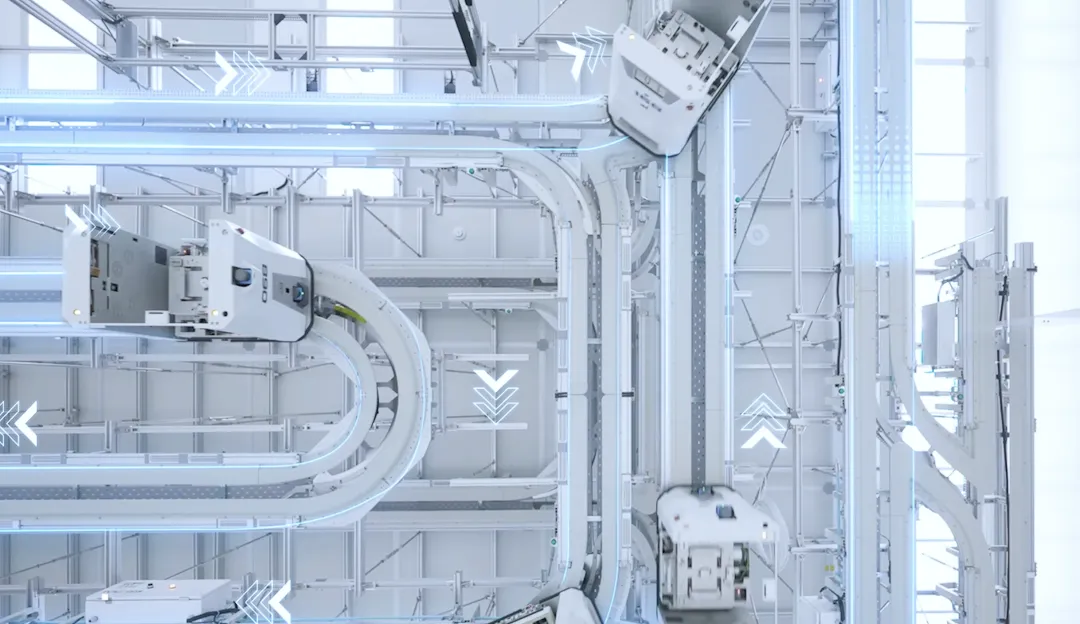
Ultimately, all of this converges into a single, seemingly simple yet highly revealing metric: ADT (Average Delivery Time).
ADT does not speak—but it reveals everything.
A deeper look uncovers a frequently overlooked fact:
Efficiency is not something achieved through operation alone—it is a capability built into the system by design.
At its core, efficiency is determined by system engineering.
In many discussions, differences in OHT are often reduced to factors such as vehicle speed or routing design. However, in real-world operations, the more decisive factors typically lie within the underlying architecture—such as the responsiveness of the control system, the stability of the network, and the reliability of the power supply infrastructure.
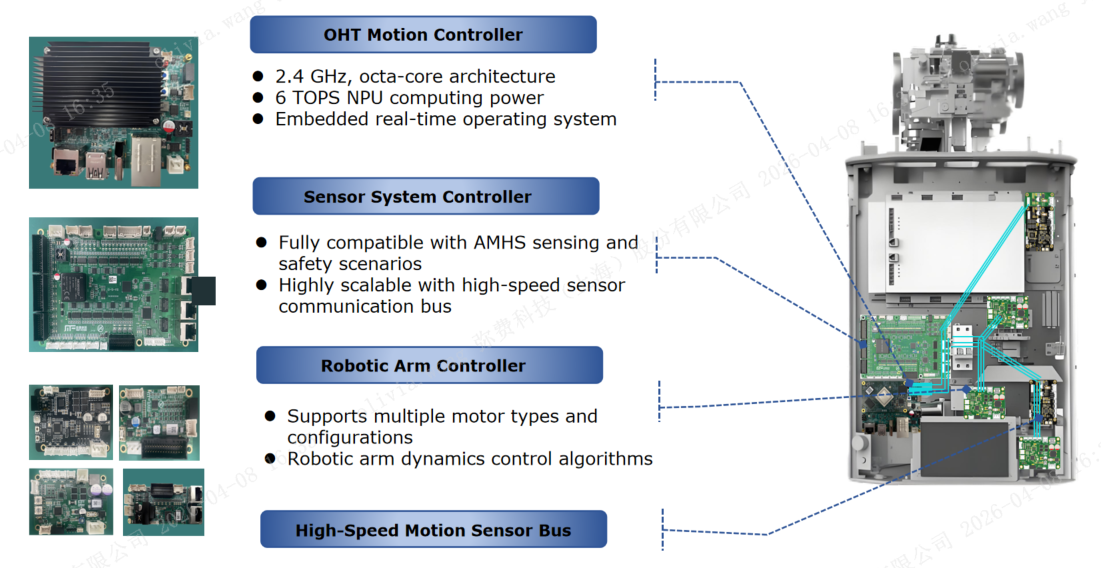
Next-Generation OHT Control Platform with Industry-Leading Computing Power and Communication Architecture
Fully self-developed embedded system, designed to support all OHT operational scenarios
Platform-based architecture with full compatibility for 100% domestically developed chips
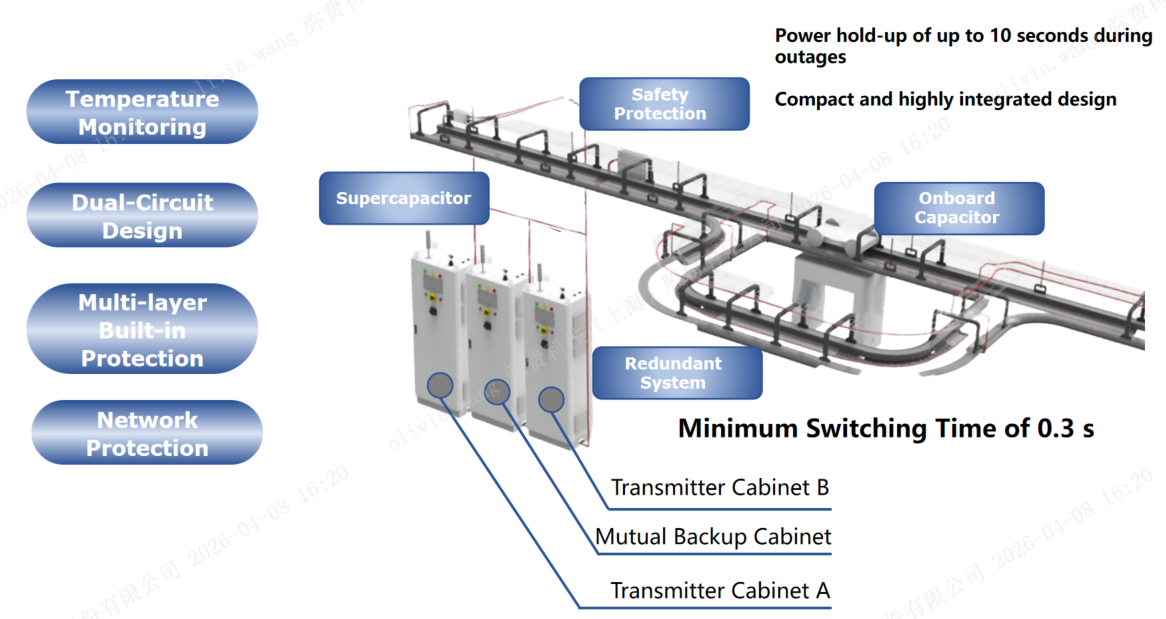
Next-Generation Power Supply System (CPS)
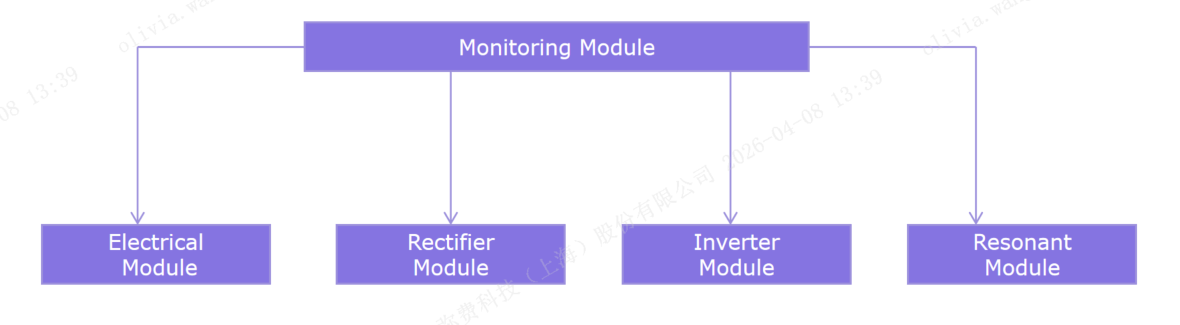
Dual redundancy architecture with multi-layer protection and distributed monitoring
Supercapacitor-enabled backup ensures zero-downtime switching during power anomalies
Supercapacitor support enables safe and controlled stopping in the event of power loss
Fully upgraded safety monitoring software for enhanced system reliability
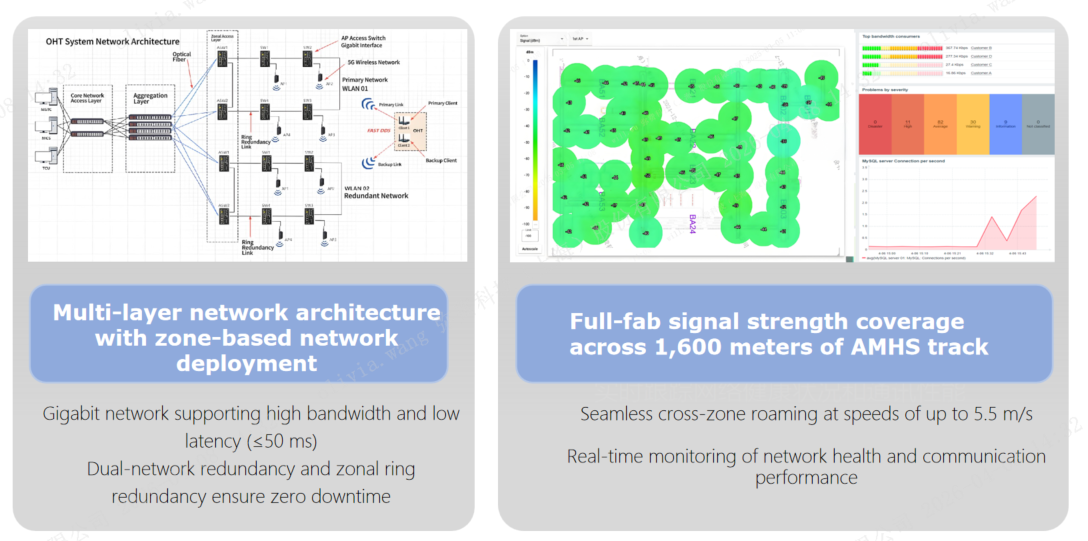
Next-Generation Wireless Network System
Low-latency, high-capacity architecture with built-in redundancy and seamless failover
Reliably supports large-scale OHT fleets with up to thousands of vehicles
Enhanced signal strength and extended coverage across wider operational areas
Optimized for complex track layouts and high-speed roaming scenarios
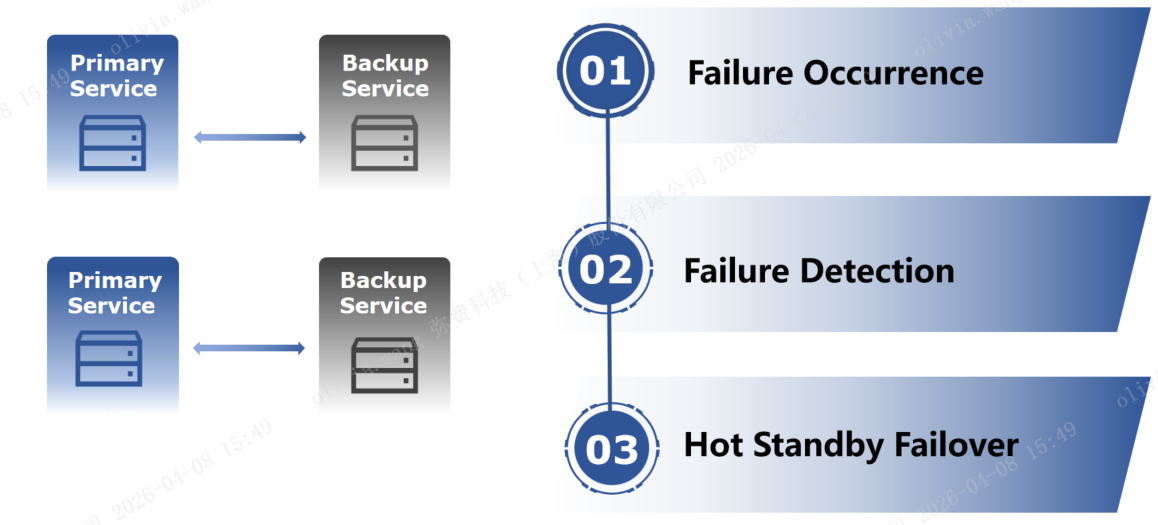
Next-Generation Hot Standby Redundancy Architecture
Full support for system software and algorithm-level redundancy
Platform designed to handle a wide range of failover and system upgrade scenarios
Zero-downtime switching, zero operational disruption, and zero data loss
These capabilities may not be visible in specification sheets, yet they become decisive under system stress—determining whether operations remain stable or begin to fluctuate.
MFSG OHT 5.0 adopts a full-chain redundancy architecture, spanning from vehicles to network switches, along with comprehensive power redundancy across all critical components. This design ensures continuous system operation under localized anomalies, preventing risks from escalating into efficiency losses.
If system architecture determines whether operations can remain stable, then in real-world execution, efficiency depends on another often underestimated dimension: continuity.
In complex track layouts, the need to frequently decelerate or wait before switches often has a greater impact than maximum speed alone.
The ability to maintain high-speed movement through consecutive switches and to compress pick-and-place cycles under high task frequency may seem like incremental improvements. In reality, these details define whether a system delivers smooth flow or fragmented movement.
Efficiency, at its core, is not about moving faster—but about being interrupted less.
However, stopping at this level still means optimizing the system, rather than optimizing AMHS as a whole.
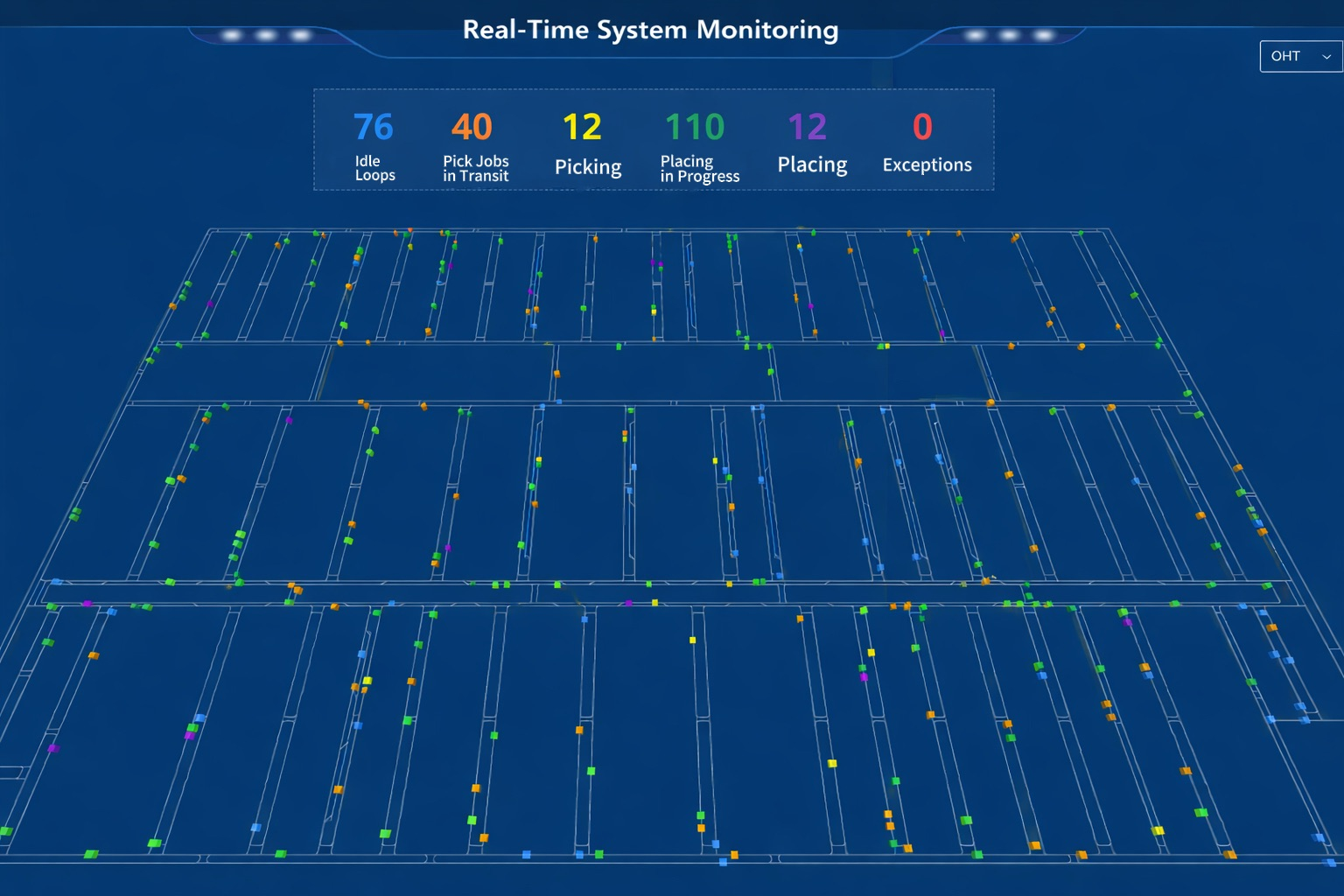
In semiconductor fabs with hundreds of OHT vehicles and thousands of tool interfaces, true complexity does not arise from individual units, but from the dynamics of the entire system—tasks are continuously generated, routes become congested, and priorities shift in real time.
In such environments, relying on localized rules or static strategies inevitably leads to a familiar outcome: local optimization, but global inefficiency.
To address this challenge, MFSG Headquarters – MeetFuture Technology, in collaboration with Huazhong University of Science and Technology, has developed a global dynamic scheduling algorithm.
Its core advantage is not simply faster computation—but greater foresight.
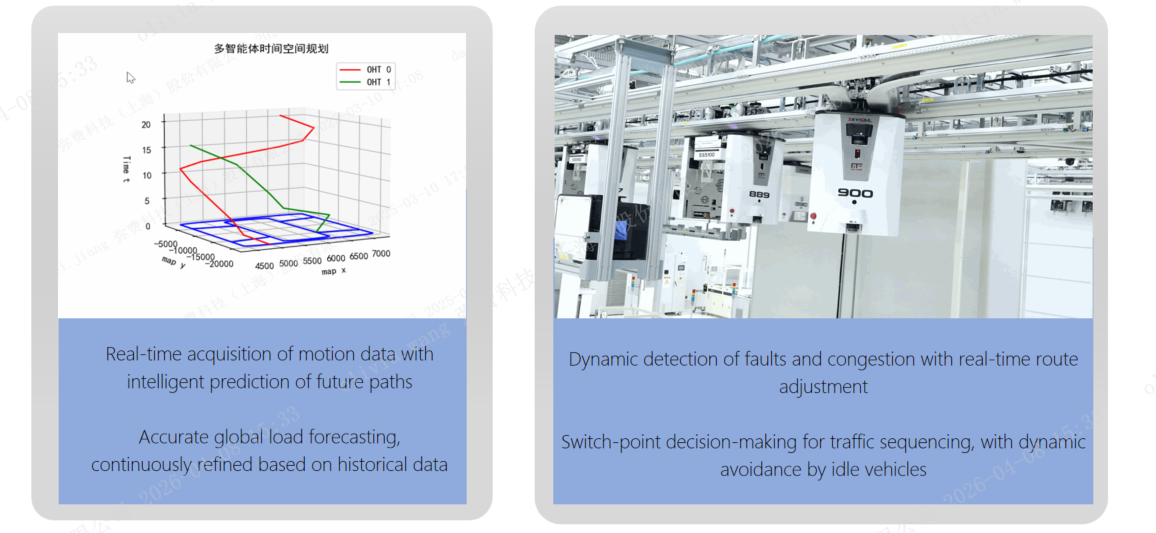
Next-Generation Path Planning Algorithm: Minimizing Total Movement Time Across the Entire OHT Fleet
By introducing a predictive rolling time window, powered by both AI models and simulation, the system no longer reacts only to the current state. Instead, it anticipates task distribution and path load over a future time horizon, continuously optimizing scheduling decisions at a global level.
This enables a fundamental shift in system behavior:
Task assignment is no longer based on selecting the nearest available vehicle, but the one that delivers the best overall system outcome.
Path planning is no longer driven solely by current distance, but proactively avoids potential congestion before it occurs.
Multi-vehicle operations are no longer constrained by sequential waiting, but enabled through coordinated vehicle–path collaboration for continuous flow.
This transition—from reactive response to predictive decision-making— fundamentally redefines how the system operates.
The results are clear and measurable: In both system-level simulations and real-world deployments, MFSG has achieved an overall reduction of approximately 20% in ADT compared to typical industry benchmarks.
As the industry reaches a stage where more companies are capable of delivering OHT systems, the real question for customers is no longer who can build one, but:
Can the system maintain efficiency under complex operating conditions?
Is its performance proven only in ideal scenarios—or in real production environments?
Are its capabilities the result of isolated optimizations—or true system-level coordination?
Being able to run is the baseline.
Running reliably is a capability.
Sustaining high efficiency over time—that is where the real differentiation lies.
On May 5, at SEMICON Southeast Asia 2026, MFSG will present its latest-generation AMHS OHT system, along with in-depth technical insights.

If you are also exploring what truly differentiates systems that may appear similar at first glance—Where does the real difference lie beneath the surface?
We invite you to join us on-site and explore this question together, in greater depth.
